Choosing the right car tyre feels overwhelming for most vehicle owners. Walk into any tyre shop and you’re immediately confronted with hundreds of options across different brands, sizes, compounds, and price points. Make the wrong choice and you compromise safety, performance, and value. Make the right choice and your vehicle transforms into a safer, more comfortable, more efficient machine. In this comprehensive guide on how to choose the right car tyre, we’ll break down every factor into simple, actionable decisions that any Indian driver can understand and apply.

Why Choosing the Right Tyre Matters More Than You Think
Before understanding how to choose, let’s understand why this decision carries such significant weight.
Your tyres represent the only four contact patches connecting your vehicle to the road. Each patch is roughly the size of your palm – four palm-sized areas of rubber upon which your entire vehicle’s safety depends during acceleration, braking, and cornering.
Wrong tyre choices create real consequences including increased accident risk during monsoons, dramatically reduced braking performance, poor fuel economy costing thousands annually, premature tyre failure, and uncomfortable driving experience across thousands of kilometers.
Getting this decision right protects your family, optimizes your investment, and enhances every kilometer you drive. Here is exactly how to do it correctly.
Step 1: Read Your Tyre Size Code
The foundation of choosing any tyre is understanding your vehicle’s required size. This information appears in three places: your vehicle owner’s manual, the sticker inside your driver’s door jamb, and the sidewall of your existing tyres.
Decoding the Tyre Size Number
Every tyre carries a standardized size code that looks like this example: 185/65 R15 88H
Understanding each component transforms confusing numbers into meaningful information.
185 – Section Width (millimeters): This number represents the tyre’s width measured from sidewall to sidewall. Wider tyres generally provide more grip but reduce fuel efficiency. Common widths for Indian passenger cars range from 155mm to 215mm.
65 – Aspect Ratio (percentage): This percentage represents the tyre’s sidewall height as a proportion of its width. A 65 aspect ratio means the sidewall height equals 65% of the 185mm width, giving approximately 120mm of sidewall. Higher aspect ratios provide more cushioning comfort while lower ratios deliver sportier handling.
R – Radial Construction: The R confirms radial construction, which is standard for all modern passenger car tyres. Radial tyres provide superior performance, comfort, and fuel efficiency compared to older bias-ply alternatives.
15 – Rim Diameter (inches): This number indicates the wheel diameter in inches. Your new tyres must match your existing wheel diameter exactly. Common sizes for Indian small cars range from 13 to 17 inches.
88 – Load Index: This crucial number indicates maximum weight each tyre can safely support. A load index of 88 means each tyre carries up to 560 kilograms. Never fit tyres with lower load index than your vehicle requires.
H – Speed Rating: This letter indicates maximum sustained speed the tyre safely handles. H rating means 210 km/h maximum. Always match or exceed your vehicle’s required speed rating.
Finding Your Correct Tyre Size
The easiest method is checking your driver’s door jamb sticker. This label shows manufacturer-recommended tyre size, recommended inflation pressure, and maximum load capacity. Always use this as your primary reference rather than measuring existing tyres, which may already be incorrect size.
Step 2: Understand Load Index and Speed Ratings
These two specifications are frequently overlooked by buyers but represent critical safety parameters.
Load Index Explained

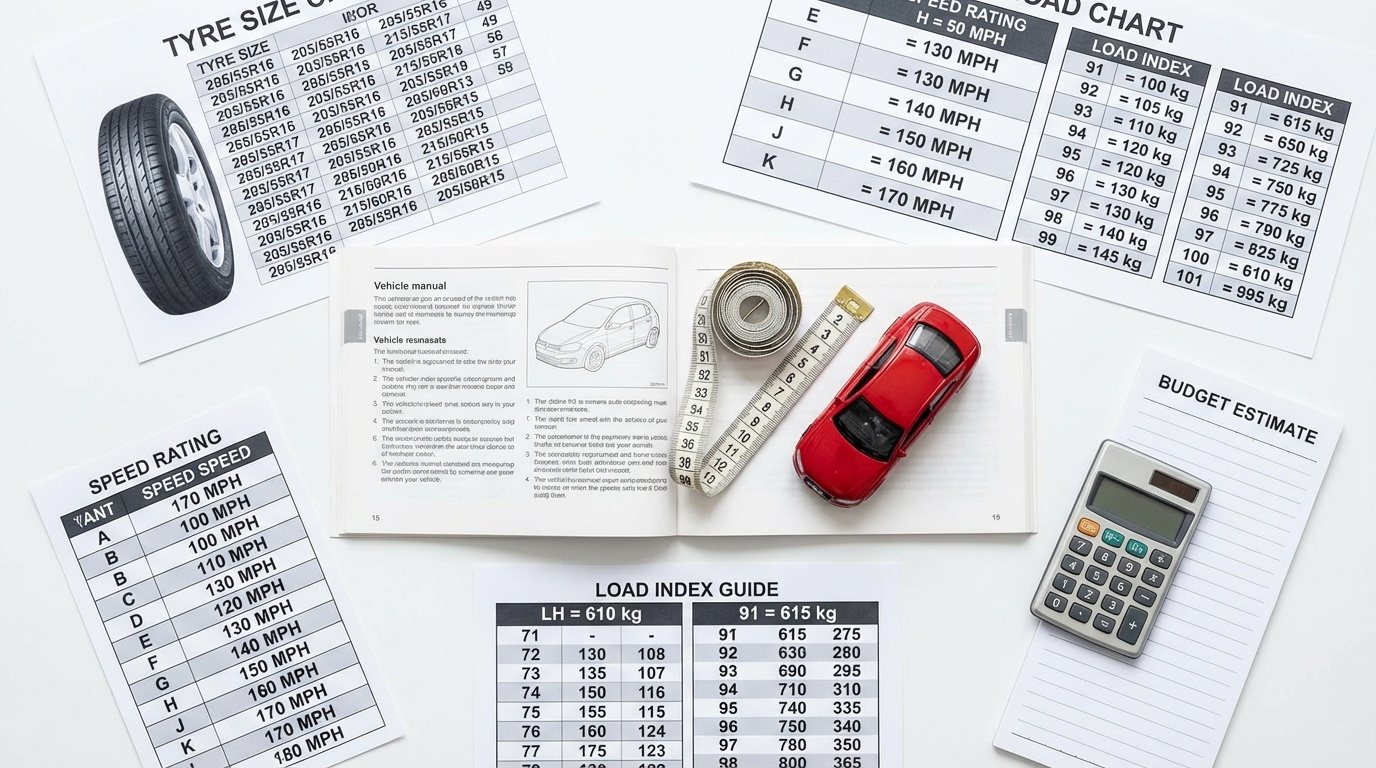
The load index number corresponds to a specific weight capacity. Here are common load index values relevant to Indian passenger cars and their weight ratings:
Load index 75 supports 387 kilograms per tyre. Load index 80 supports 450 kilograms. Load index 85 supports 515 kilograms. Load index 88 supports 560 kilograms. Load index 91 supports 615 kilograms. Load index 94 supports 670 kilograms. Load index 97 supports 730 kilograms.
To verify adequacy, divide your vehicle’s maximum load capacity by four. The resulting number must not exceed your tyre’s load rating. Exceeding load ratings risks tyre failure, especially during highway driving at sustained speeds.
Speed Rating Explained
Speed ratings use letters to indicate maximum safe sustained speed. Understanding these letters helps match tyres to your driving reality.
Q rating (160 km/h): Basic tyres for city-only vehicles rarely exceeding 100 km/h.
S rating (180 km/h): Suitable for most Indian city and highway driving at normal speeds.
T rating (190 km/h): Common for family sedans and hatchbacks used on national highways.
H rating (210 km/h): Popular for sportier hatchbacks and performance-oriented drivers.
V rating (240 km/h): Required for high-performance vehicles and driving enthusiasts.
W rating (270 km/h): Premium sports cars and performance sedans.
Important Rule: Never fit tyres with lower speed rating than your vehicle manufacturer specifies. Doing so creates dangerous failure risk at highway speeds and voids your vehicle warranty.
Step 3: Identify Your Primary Driving Conditions
Different driving environments demand different tyre characteristics. Honest self-assessment of your driving patterns guides optimal tyre selection.
Urban City Driving (80%+ city roads)
Characteristics of urban driving include frequent stops and starts, low average speeds (30-60 km/h), tight parking maneuvers, exposure to potholes and rough patches, and monsoon puddle navigation.
Tyre Priorities for City Driving: Comfort and smooth ride absorb urban road irregularities effectively. Fuel efficiency matters when sitting in traffic constantly. Durable sidewalls resist curb damage during parking. Moderate wet grip handles typical rain conditions. Budget to mid-range tyres suffice for purely urban use.
Recommended Tyre Type: All-season passenger tyres with comfort-focused construction.
Highway and Long Distance Driving (40%+ highway)
Highway driving characteristics include sustained high speeds (80-120 km/h), long continuous kilometers, need for stability and low fatigue, minimal sudden stops, and varied weather conditions.
Tyre Priorities for Highway Driving: High-speed stability prevents wandering at sustained speeds. Low noise reduces driver fatigue during long journeys. Heat resistance handles sustained high-speed operation. Quality construction maintains performance across thousands of kilometers. Premium tyres justify investment for frequent highway users.
Recommended Tyre Type: Touring or grand touring tyres with heat-resistant compounds.
Mixed Driving (balanced city and highway)
Most Indian drivers fall into this category, requiring tyres balancing multiple demands effectively.
Tyre Priorities for Mixed Driving: All-around balanced performance across conditions. Reasonable longevity for cost efficiency. Adequate wet grip for monsoon confidence. Acceptable comfort without specialization. Mid-range tyres typically optimal for mixed usage patterns.
Recommended Tyre Type: All-season comfort tyres with balanced compound formulation.
Step 4: Assess Seasonal and Weather Requirements
India’s diverse climate creates different tyre demands across regions and seasons.
Monsoon-Heavy Regions (Kerala, Mumbai, Bangalore, Northeast India)
Drivers experiencing intense monsoons should prioritize wet weather performance above all other characteristics. Critical wet performance features include deep circumferential grooves evacuating water rapidly, silica-enhanced compounds maintaining wet grip, multiple sipes creating additional biting edges, and hydroplaning resistance at realistic speeds.
Top Monsoon Priority Recommendations: CEAT SecuraDrive leads this category with exceptional hydroplaning resistance. Michelin Energy XM2 follows closely with silica compound technology. Apollo Amazer 4G Life provides good wet performance at competitive pricing.
Arid Regions (Rajasthan, Gujarat, parts of Maharashtra)
Drivers in hot, dry regions face different challenges including extreme heat accelerating rubber degradation, minimal wet weather concerns, dusty road surfaces affecting grip, and high ambient temperatures increasing tyre pressure.
Hot Climate Priority Features: Heat-resistant rubber compounds maintain structural integrity. Robust construction handles temperature extremes. Regular pressure monitoring compensates for heat-related expansion. Durability-focused compounds resist heat degradation.
Hilly Regions (Himachal Pradesh, Uttarakhand, Northeast hills)
Mountain driving creates unique tyre demands including steep gradients requiring maximum braking performance, sharp corners demanding lateral grip, occasional cold weather and frost, and rough mountain road surfaces.
Mountain Driving Priority Features: Strong braking performance for steep descents. Lateral stability through corners on mountain roads. Sidewall strength for rocky terrain contact. Temperature flexibility across altitude-related variations.
Step 5: Set Your Budget Realistically
Budget planning for tyres requires thinking beyond initial purchase price toward total ownership cost over the tyre’s complete lifespan.
Understanding True Tyre Cost
Many buyers make the mistake of comparing only sticker prices without considering how long each tyre actually lasts. A more expensive tyre lasting twice as long often costs less per kilometer than a cheap alternative requiring early replacement.
True Cost Calculation Method:
Divide the tyre’s purchase price by expected lifespan in kilometers. This gives cost-per-kilometer, the only truly meaningful comparison number.
Practical Example:
Budget tyre costing ₹3,200 lasting 38,000 kilometers gives ₹0.084 per kilometer.
Premium tyre costing ₹7,500 lasting 70,000 kilometers with ₹2,000 fuel savings gives effective cost of ₹5,500 divided by 70,000 equaling ₹0.079 per kilometer.
This reveals the premium tyre actually costs 6% less per kilometer while delivering dramatically superior performance throughout its life.
Budget Category Framework
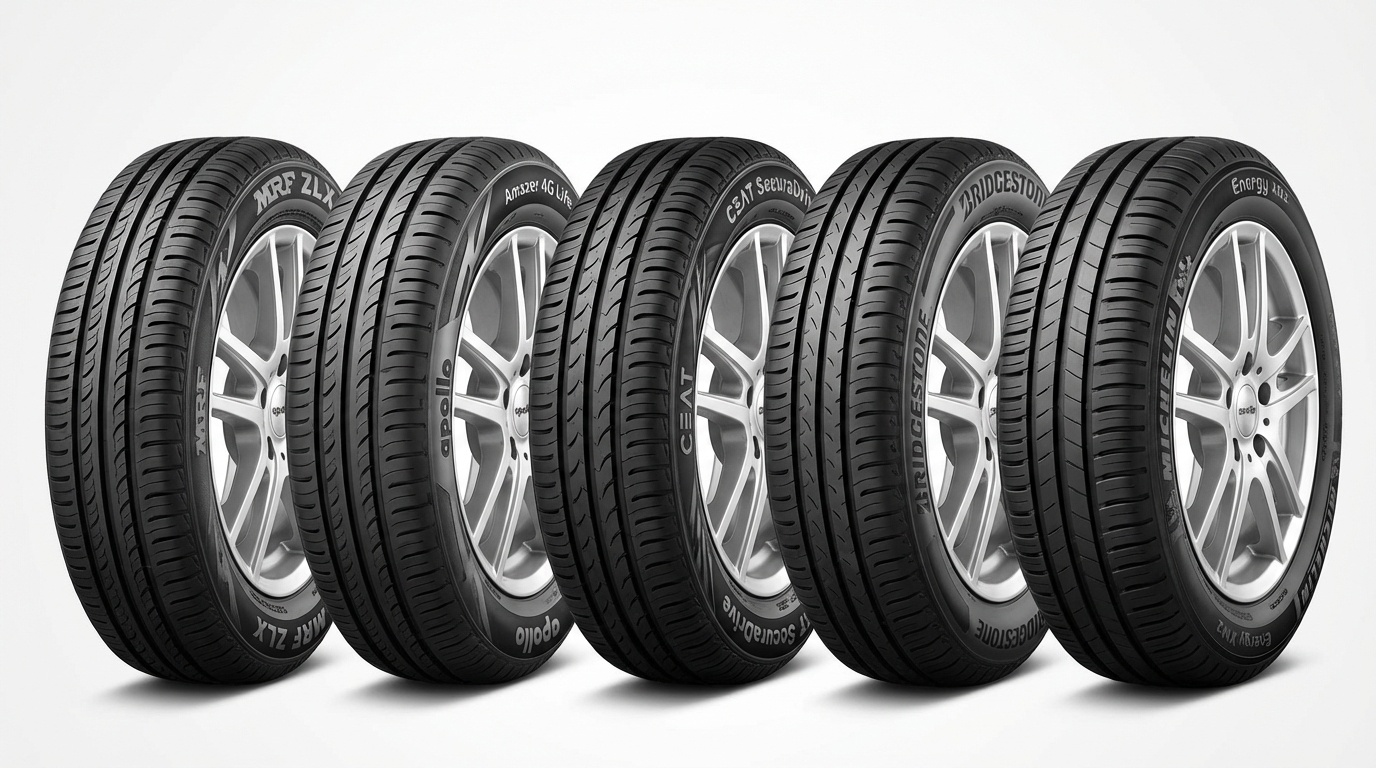
Entry Level (₹2,500-₹4,000 per tyre): Suitable for older vehicles, very low mileage drivers, and extreme budget constraints. Adequate safety but limited performance and longevity. Brands: MRF ZLX, JK Ultima NXT, basic CEAT models.
Mid-Range (₹4,000-₹6,500 per tyre): Optimal value for most Indian drivers. Significantly better performance than budget options with reasonable pricing. Brands: Apollo Amazer 4G Life, CEAT SecuraDrive, Bridgestone B290.
Premium (₹6,500-₹11,000 per tyre): Best total value for high-mileage drivers and quality-focused owners. Superior performance across all categories. Brands: Michelin Energy XM2, Continental ComfortContact, Bridgestone Turanza.
Step 6: Evaluate Key Performance Priorities
Different drivers have different priorities. Ranking these helps narrow your selection effectively.
Wet Weather Safety Priority
If monsoon safety ranks as your primary concern, choose tyres with silica-enhanced compounds for wet flexibility, wide circumferential grooves for water evacuation, multiple lateral sipes for biting edges, and proven hydroplaning resistance in independent tests.
Top Wet Weather Performers: Michelin Energy XM2, CEAT SecuraDrive, Apollo Amazer 4G Life.
Fuel Efficiency Priority
If minimizing running costs matters most, prioritize low rolling resistance compounds, Green X or equivalent eco-certifications, lightweight construction reducing rotational mass, and optimized tread patterns minimizing energy loss.
Top Fuel Efficiency Performers: Michelin Energy XM2 (3-5% improvement), Apollo Amazer 4G Life (2-4% improvement), Bridgestone B290 (2-3% improvement).
Maximum Longevity Priority
If extending replacement intervals matters most, look for advanced wear-resistant compounds, even wear-promoting tread designs, robust construction maintaining integrity throughout life, and strong manufacturer mileage warranties.
Top Longevity Performers: Michelin Energy XM2 (60,000-75,000 km), Apollo Amazer 4G Life (45,000-55,000 km), Bridgestone B290 (45,000-55,000 km).
Comfort and Noise Priority
If ride quality and cabin quietness matter most, prioritize variable pitch tread patterns reducing noise, comfortable sidewall construction absorbing impacts, and refined compounds minimizing vibration transmission.
Top Comfort Performers: Continental ComfortContact CC6, Michelin Energy XM2, Bridgestone Turanza T001.
Step 7: Choose the Right Brand

Brand selection involves balancing reputation, technology, availability, pricing, and after-sales service.
Indian Brands: Value and Availability
MRF: India’s largest tyre manufacturer with unmatched distribution network. Strong value proposition with decent quality across all segments. Best suited for budget-conscious buyers and city drivers.
Apollo Tyres: Strong R&D investment producing genuinely competitive products. The Amazer 4G Life competes with global mid-range alternatives effectively. Excellent value-to-performance ratio.
CEAT: Consistent quality with innovative safety-focused products. The SecuraDrive demonstrates genuine engineering investment in wet weather capability. Good service network across India.
JK Tyres: Reliable budget option with improving technology. Adequate for basic transportation needs without premium aspirations.
Global Brands: Premium Performance
Michelin: Consistently ranks among world’s best tyre manufacturers. Energy XM2 specifically engineered for Asian conditions provides genuine premium value. Best overall choice when budget permits.
Bridgestone: World’s largest tyre manufacturer with extensive technology resources. B290 and Turanza products deliver reliable premium-to-mid-range performance. Strong service network.
Continental: German engineering precision delivering excellent all-around performance. ComfortContact range particularly excels in refinement and comfort.
Goodyear: American brand with strong wet weather technology. Assurance TripleMax 2 delivers sporty-comfort balance at competitive pricing.
Service Network Consideration
Premium performance means nothing if you cannot find service or replacement. Before finalizing brand choice, verify dealer network in your city, availability of your specific size, warranty claim process simplicity, and roadside assistance coverage.
Step 8: Check the Tyre Age and DOT Code
Even brand new tyres can be dangerously old. Understanding tyre age protects against purchasing degraded rubber that looks new but performs dangerously.
Reading the DOT Code
Every tyre carries a Department of Transportation code on its sidewall. The last four digits of this code reveal manufacturing date. The first two digits indicate manufacturing week and the last two indicate manufacturing year.
Example: DOT code ending in 2423 means the tyre was manufactured in the 24th week of 2023.
Age Guidelines
Regardless of visual condition or tread depth, replace tyres exceeding these age thresholds. Never purchase new tyres manufactured more than two years before purchase date. Replace tyres after six years regardless of remaining tread. Never use any tyre older than ten years even with apparent adequate tread remaining.
Rubber compounds degrade chemically with age even when stored properly. Old rubber loses flexibility, develops microscopic cracks, and fails catastrophically without warning. Always check DOT codes before purchasing, especially during sales or from smaller retailers.
Step 9: Verify Fitment During Installation
Choosing the right tyre means nothing if installation compromises performance.
Essential Installation Checks
Wheel Balancing: Always balance new tyres during installation. Unbalanced tyres create vibrations affecting comfort and causing uneven wear.
Tyre Rotation Direction: Directional tyres have arrow markings indicating rotation direction. Installing backwards dramatically reduces wet weather performance and longevity.
Inflation Pressure: Set tyres to manufacturer-recommended pressure immediately after installation. Incorrect pressure from the first kilometer compromises performance.
Alignment Verification: Installing new tyres without checking alignment wastes money through premature uneven wear. Always verify alignment with new tyre fitment.
Valve Replacement: Request new valve stems with every tyre change. Old valves leak slowly, causing gradual pressure loss and performance degradation.
Step 10: Plan Your Ongoing Maintenance Schedule
The best tyre choice delivers full value only with consistent maintenance discipline.
Monthly Tasks
Check and adjust inflation pressure to manufacturer-recommended levels. Visual inspection for cuts, bulges, embedded objects, and abnormal wear patterns. Clean tread grooves of embedded stones that cause gradual damage.
Every 8,000-10,000 Kilometers
Rotate tyres following the correct pattern for your vehicle’s drivetrain. For front-wheel drive vehicles (most Indian hatchbacks and sedans), move front tyres straight to rear and cross rear tyres to front positions.
Every 10,000-12,000 Kilometers
Professional wheel alignment check prevents uneven wear. Wheel balancing check if vibrations appear. Tread depth measurement to track wear progression.
Annual Tasks
Complete tyre inspection including sidewall condition check. DOT code verification confirming tyres within safe age limits. Assessment of whether rotation and alignment history has maintained even wear.
Common Mistakes Indian Tyre Buyers Make
Understanding frequent errors helps you avoid costly decisions.
Buying Based Only on Price: The cheapest option rarely provides best value when total ownership cost is properly calculated.
Ignoring Load and Speed Ratings: Fitting tyres with inadequate ratings for your vehicle creates dangerous failure risk, particularly when fully loaded or driving at highway speeds.
Mixing Different Tyres: Installing different brands or models on the same axle creates unpredictable handling, especially during emergency maneuvers.
Neglecting DOT Code Checks: Purchasing old tyres that look new but have chemically degraded rubber is a common mistake when buying during sales or from discounters.
Skipping Alignment After Installation: New tyres on misaligned wheels wear rapidly and unevenly, eliminating their longevity advantage within the first 10,000 kilometers.
Delaying Replacement: Driving on excessively worn tyres creates dramatically increased accident risk, particularly during monsoon conditions when tread depth directly determines wet grip capability.
Quick Decision Checklist
Use this checklist when making your final tyre selection decision.
Confirm correct size matching vehicle door jamb specification. Verify load index meets or exceeds vehicle requirement. Confirm speed rating meets or exceeds vehicle specification. Assess primary driving conditions honestly (city versus highway). Identify top three performance priorities from your specific needs. Calculate budget using cost-per-kilometer rather than sticker price. Check DOT code confirming tyre manufactured within past two years. Verify brand service network availability in your location. Plan immediate post-installation alignment and balancing. Schedule maintenance reminders for pressure checks and rotation.
Final Recommendations Summary
For Budget-Conscious City Drivers: MRF ZLX or Apollo Amazer 4G Life depending on budget flexibility. Both provide adequate safety with reasonable longevity for typical urban usage.
For Safety-Prioritized Family Use: CEAT SecuraDrive for monsoon-heavy regions or Michelin Energy XM2 when budget permits. Both deliver superior wet weather margins protecting your family during emergencies.
For High-Mileage Highway Drivers: Michelin Energy XM2 provides best total value through extended lifespan, fuel savings, and consistent performance throughout its long service life.
For Performance Enthusiasts: Bridgestone Turanza T001 or Goodyear Assurance TripleMax 2 deliver engaging driving characteristics without sacrificing safety.
For Premium Vehicle Owners: Michelin Energy XM2 or Continental ComfortContact CC6 match your vehicle’s capabilities and refinement expectations appropriately.
Conclusion: Invest Time Before Investing Money
Choosing the right car tyre deserves more attention than most Indian drivers give it. The ten-step process outlined in this guide transforms an overwhelming decision into a logical, manageable process producing consistently good outcomes.
Start with your correct size, verify load and speed ratings, honestly assess your driving conditions, set a realistic budget using cost-per-kilometer thinking, identify your top performance priorities, choose a brand with adequate service network, check the DOT manufacturing date, and plan proper installation with ongoing maintenance.
Following this process every time you need new tyres ensures you never overpay for unnecessary features or underpay at the expense of safety. Your tyres work harder than any other component on your vehicle. They deserve thoughtful selection, proper installation, and consistent maintenance throughout their service life.
The right tyre choice for your specific situation exists among the excellent options available in India’s 2026 market. Use this guide to find it, fit it correctly, maintain it consistently, and enjoy thousands of safe, comfortable, efficient kilometers with complete confidence.