
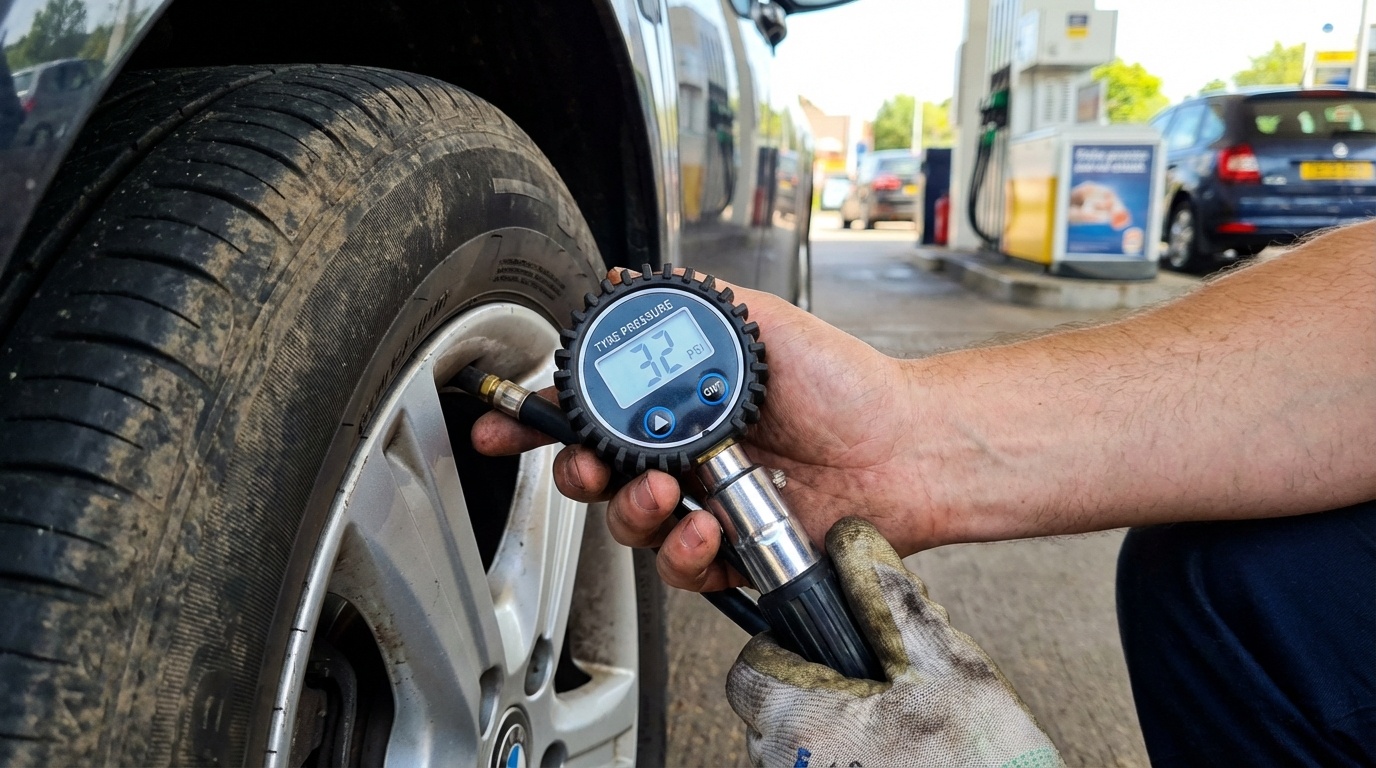
Tyre pressure is one of those things that almost every car owner knows is important — but most people never actually check. You might top it up when the tyre looks visually flat, or rely on a petrol station attendant to do it for you. But by the time a tyre looks flat to the naked eye, the pressure is already dangerously low.
Incorrect tyre pressure affects your fuel efficiency, tyre life, braking distance, and handling — all at the same time. The good news is that checking tyre pressure takes less than 5 minutes and you can do it yourself at home or at any petrol station. In this guide, we walk you through exactly how to check tyre pressure, step by step, with everything an Indian car owner needs to know.
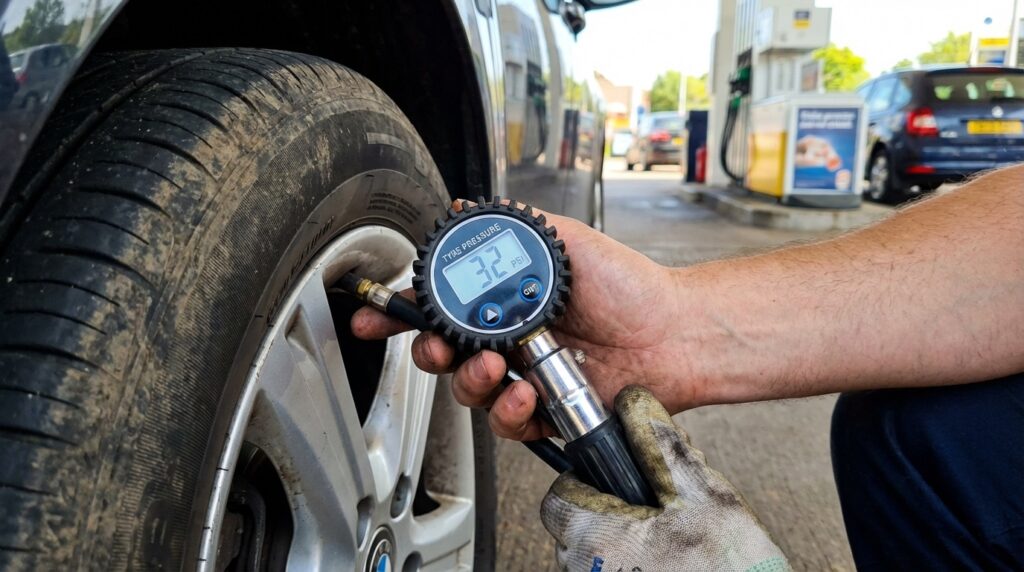
Why Tyre Pressure Matters So Much
Before we get into how to check tyre pressure, it helps to understand why it matters so much. Your tyre is not just a rubber ring — it is an air chamber. The air inside carries the entire weight of your car. When pressure is off, everything suffers:
| Condition | Under-Inflated Tyre | Over-Inflated Tyre |
| Fuel efficiency | Drops by up to 10% | Slightly reduced |
| Tyre wear | Edges wear faster | Centre wears faster |
| Braking distance | Increases significantly | Increases on wet roads |
| Handling | Sluggish, heavy steering | Nervous, twitchy steering |
| Blowout risk | Very high — heat builds up | High — tyre is over-stressed |
| Ride comfort | Soft but unstable | Harsh and bumpy |
What Is the Correct Tyre Pressure for My Car?
Every car has a manufacturer-recommended tyre pressure that is specific to that vehicle. This is not a universal number — it varies based on the car’s weight, tyre size, and design. The recommended pressure is usually given in PSI (Pounds per Square Inch) or Bar.
Where to find the correct pressure for your car:
- Driver’s door jamb sticker: Open the driver’s side door and look at the metal frame. There will be a sticker showing the recommended tyre pressure for both front and rear tyres.
- Owner’s manual: Check the tyre and wheel section of your car’s manual.
- Fuel cap sticker: Some cars have the tyre pressure printed inside the fuel cap.
- Tyre itself: The sidewall shows the maximum pressure — but always use the car manufacturer’s recommendation, not the tyre’s maximum.
As a general reference for popular Indian cars, most hatchbacks and small sedans run at 30–33 PSI in front tyres and 28–30 PSI in rear tyres. SUVs typically run slightly higher at 33–36 PSI. Always verify with your specific car’s recommendation.
What You Need to Check Tyre Pressure
You do not need any special equipment or mechanical knowledge. Here is what you need:
- A tyre pressure gauge: You can buy a basic digital or dial gauge for Rs. 150–500 from any auto parts shop or online. Many petrol stations also have gauges attached to the air pump.
- The correct pressure number: Get this from your car’s door jamb sticker or owner’s manual before you start.
- A valve cap remover: The valve cap unscrews by hand — no tool needed.
- An air pump (if needed): Available free or for a small charge at petrol stations across India.
How to Check Tyre Pressure: Step-by-Step
Follow these steps carefully and you will get an accurate reading every time:
Step 1: Check When the Tyre Is Cold
This is the most important rule. Always check tyre pressure when the tyres are cold — meaning the car has not been driven for at least 3 hours, or has been driven less than 2 km at low speed. When you drive, friction heats up the air inside the tyre and pressure rises. A hot tyre will give you a false high reading, making it seem fine when it may actually be low.
The best time to check is first thing in the morning before you start the car.
Step 2: Locate the Tyre Valve Stem
Each tyre has a small rubber or metal valve stem — it is a short tube about 2–3 cm long sticking out from the inner edge of the rim. You will see a small cap on the end of it. This is where you attach the pressure gauge.
Step 3: Remove the Valve Cap
Unscrew the small cap from the valve stem by turning it anticlockwise. Keep it in your pocket or a safe place — do not lose it. The cap protects the valve from dust and dirt. Without it, the valve can get clogged and start leaking slowly.
Step 4: Attach the Pressure Gauge
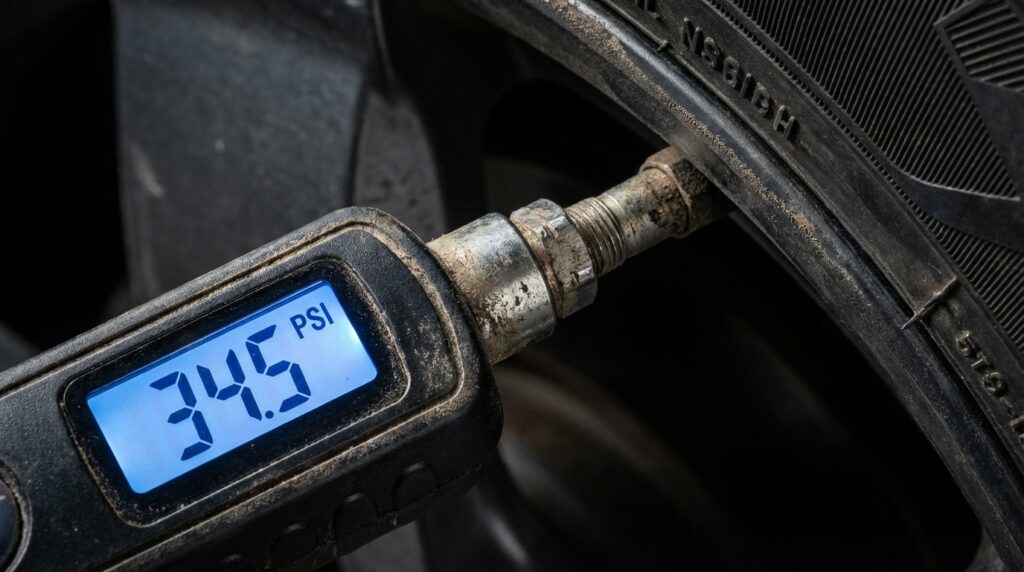
Press the opening of your tyre pressure gauge firmly and straight onto the valve stem. You will hear a brief hiss of air — this is normal and means a good seal is forming. Press it on quickly and firmly. If you hear a continuous hiss, the gauge is not sealing properly — reposition it and try again.
Step 5: Read the Pressure
The gauge will instantly display the current pressure in PSI or Bar. On a digital gauge, the reading appears on the screen. On a dial gauge, the needle points to the pressure. On an old-style stick gauge, a small bar pops out showing the reading.
Note down the reading and compare it to your car’s recommended pressure. Check all four tyres one by one, and also check the spare tyre if your car has one.
Step 6: Add or Release Air as Needed
If the pressure is too low, go to a petrol station and use the air pump to add air. Attach the pump nozzle to the valve stem and add air in short bursts, checking the pressure after each burst until you reach the correct level.
If the pressure is too high, use the small pin in the centre of the valve stem to release air. Press it briefly with a pen tip or the back of the gauge — air will release. Check the pressure again after a few seconds.
Step 7: Replace the Valve Cap
Once the pressure is correct, screw the valve cap back on clockwise until it is snug. Do not overtighten — it is plastic and can crack. Repeat the process for all remaining tyres including the spare.
How Often Should You Check Tyre Pressure in India?
Most tyre manufacturers and car makers recommend checking tyre pressure at least once a month. But in Indian conditions, you may need to check more frequently due to:
- Extreme summer heat: High temperatures in Indian summers (April–June) cause pressure to rise. Check every 2 weeks during peak summer.
- Monsoon season: Sudden temperature drops during rain can reduce pressure. Check before and after heavy rainfall periods.
- Before long trips: Always check all four tyres plus the spare before any highway journey of 200 km or more.
- After hitting a big pothole: Indian roads are notorious for potholes. A hard impact can cause slow air leaks — check pressure the next morning.
- When you notice any handling change: If the car feels heavier to steer, drifts to one side, or the ride feels different, check tyre pressure immediately.
TPMS — Does Your Car Already Monitor Tyre Pressure?
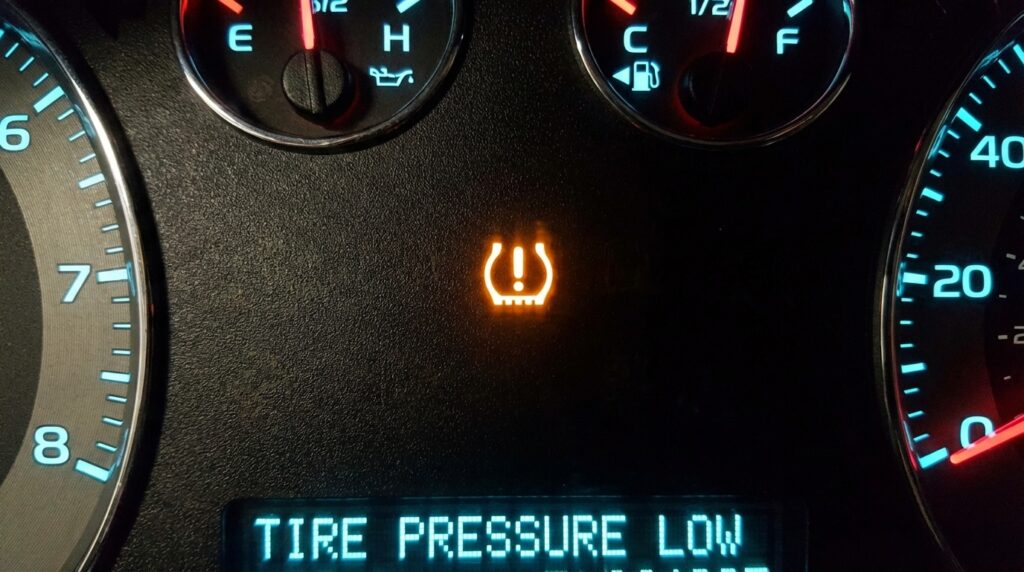
Many modern cars sold in India today come with a Tyre Pressure Monitoring System (TPMS). This system has sensors inside each tyre that continuously monitor pressure and alert you on the dashboard when any tyre drops significantly below the recommended level.
If your car has TPMS, you will see a warning light that looks like a cross-section of a tyre with an exclamation mark inside. When this light comes on, check your tyre pressure immediately.
However — and this is important — do not rely on TPMS alone. TPMS typically warns you only when pressure drops 25% or more below the recommended level. A tyre can be significantly under-inflated and causing damage without triggering the TPMS light. Manual checks are still important even if your car has TPMS.
Make Tyre Pressure Checks a Monthly Habit
Checking tyre pressure is one of the simplest and most impactful things you can do for your car. It takes 5 minutes, costs nothing if you have your own gauge, and it directly affects your safety, fuel efficiency, and tyre life. A Rs. 300 pressure gauge can save you thousands in tyre replacements and fuel costs over time.
Set a reminder on your phone for the first day of every month — check all four tyres and the spare. Do it cold, in the morning, before you drive anywhere. It is a small habit with a big payoff. Properly inflated tyres grip better, brake shorter, last longer, and give you better mileage — every single day.
Looking for the right tyres for your car? Browse our full range at the best prices. Visit our website today and drive with total confidence!
