Most Indian car owners get their oil changed regularly, check tyre pressure occasionally, and take their car for servicing on schedule. But there is one simple maintenance task that almost everyone ignores — tyre rotation. And it is costing them thousands of rupees every year in premature tyre replacements.
Tyre rotation is one of the easiest and most cost-effective ways to extend the life of your tyres significantly. Done correctly and on schedule, it can add tens of thousands of kilometres to your tyre life, improve your car’s handling, and even boost fuel efficiency. In this complete tyre rotation guide, we cover everything you need to know — what it is, why it matters, when to do it, and which pattern is right for your car.
What Is Tyre Rotation?
Tyre rotation means moving each tyre from its current position to a different position on the car — front to back, side to side, or diagonally — according to a specific pattern. The goal is to ensure that all four tyres wear down at the same rate so that no single tyre gets excessively worn while the others remain relatively new.
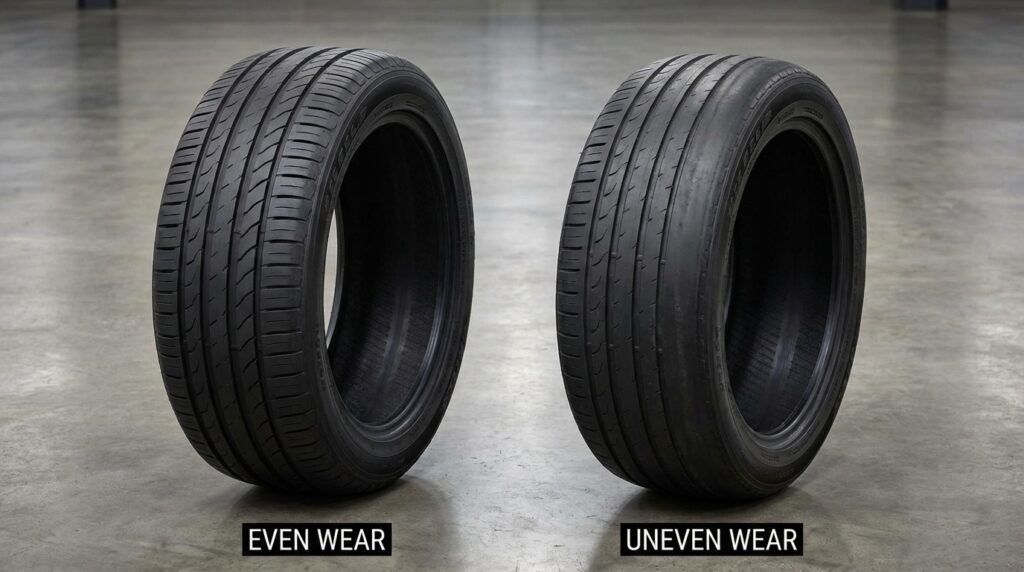
Without rotation, tyres wear unevenly based on their position. Front tyres of a front-wheel-drive car (like most Indian hatchbacks and sedans) carry the engine weight, handle steering, and transmit power to the road — all at the same time. This means front tyres wear two to three times faster than rear tyres. Without rotation, you end up replacing front tyres twice while rear tyres still have plenty of life left.
Why Tyre Rotation Is So Important — The Real Benefits
Here is exactly what you gain by rotating your tyres on schedule:
| Benefit | What It Means for You |
| Longer tyre life | Even wear means all 4 tyres last much longer — you replace all four at once instead of pairs repeatedly |
| Save money | Replacing tyres less frequently saves Rs. 10,000 to Rs. 40,000+ over the life of your car |
| Better handling | Evenly worn tyres give balanced grip on all four corners — your car handles predictably |
| Improved safety | No single tyre becomes dangerously worn while others are fine — consistent grip all around |
| Better fuel efficiency | Evenly worn tyres roll more efficiently than a set with one heavily worn tyre dragging |
| Smoother ride | Uneven wear causes vibration — rotation prevents this and keeps the ride smooth |
When Should You Rotate Your Tyres?
The standard recommendation from most tyre manufacturers and car makers is to rotate your tyres every 8,000 to 10,000 km. For most Indian drivers who cover 12,000 to 15,000 km per year, this means rotating tyres roughly once or twice a year.
The easiest way to remember is to rotate your tyres every time you get an oil change — most modern cars need oil changes every 5,000 to 10,000 km anyway, so the schedules align conveniently.
Also rotate your tyres immediately if you notice any of these signs:
- Visible uneven tread wear between front and rear tyres
- The car pulling to one side during normal driving
- Vibration felt through the steering wheel or seat at highway speeds
- One tyre noticeably more worn than the others when you visually inspect them
Tyre Rotation Patterns — Which One Is Right for Your Car?
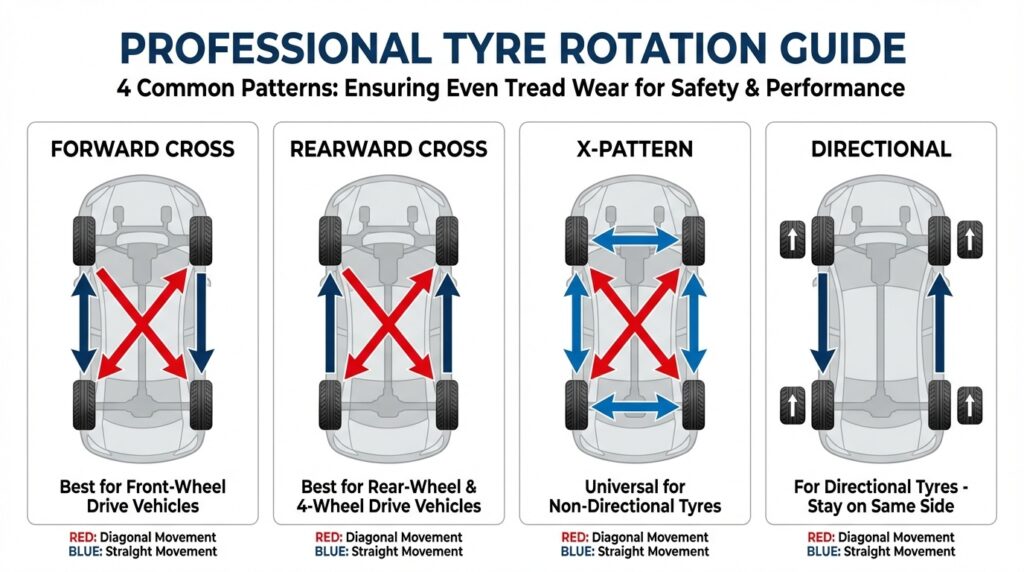
Not all cars use the same rotation pattern. The correct pattern depends on whether your car is front-wheel drive, rear-wheel drive, or all-wheel drive, and whether your tyres are directional or non-directional. Here are the main patterns:
1. Forward Cross Pattern — For Front-Wheel Drive (FWD) Cars
This is the most common rotation pattern in India because most popular Indian cars — Maruti Swift, Hyundai i20, Tata Nexon, Honda City — are front-wheel drive.
How it works:
- Front Left tyre → moves straight back to Rear Left
- Front Right tyre → moves straight back to Rear Right
- Rear Left tyre → moves diagonally to Front Right
- Rear Right tyre → moves diagonally to Front Left
The front tyres (which wear faster) go straight to the back. The rear tyres cross over when moving to the front, ensuring all four positions see different wear patterns over time.
2. Rearward Cross Pattern — For Rear-Wheel Drive (RWD) and AWD Cars
Used for rear-wheel drive cars (like some older Mahindra and Tata models) and most AWD/4WD SUVs.
How it works:
- Rear Left tyre → moves straight forward to Front Left
- Rear Right tyre → moves straight forward to Front Right
- Front Left tyre → moves diagonally to Rear Right
- Front Right tyre → moves diagonally to Rear Left
3. X-Pattern — For Equal Wear on All Four Tyres
This pattern works well for FWD cars and is sometimes recommended when all four tyres show similar wear levels. Every tyre moves diagonally — front left to rear right, front right to rear left, rear left to front right, rear right to front left. It ensures maximum variation in position over time.
4. Front to Rear (Same Side) — For Directional Tyres Only
Some tyres are directional — they have a V-shaped tread pattern designed to rotate in one specific direction. You can see an arrow on the sidewall showing the direction of rotation. These tyres cannot be moved side to side because they would then rotate the wrong way. For directional tyres, rotation is only front to back on the same side — Front Left to Rear Left, Front Right to Rear Right.
Check your tyre sidewall for an arrow or the word ROTATION or DIRECTION before deciding on a pattern. If your tyres are directional, only use the same-side front-to-rear pattern.
How to Get Tyre Rotation Done in India
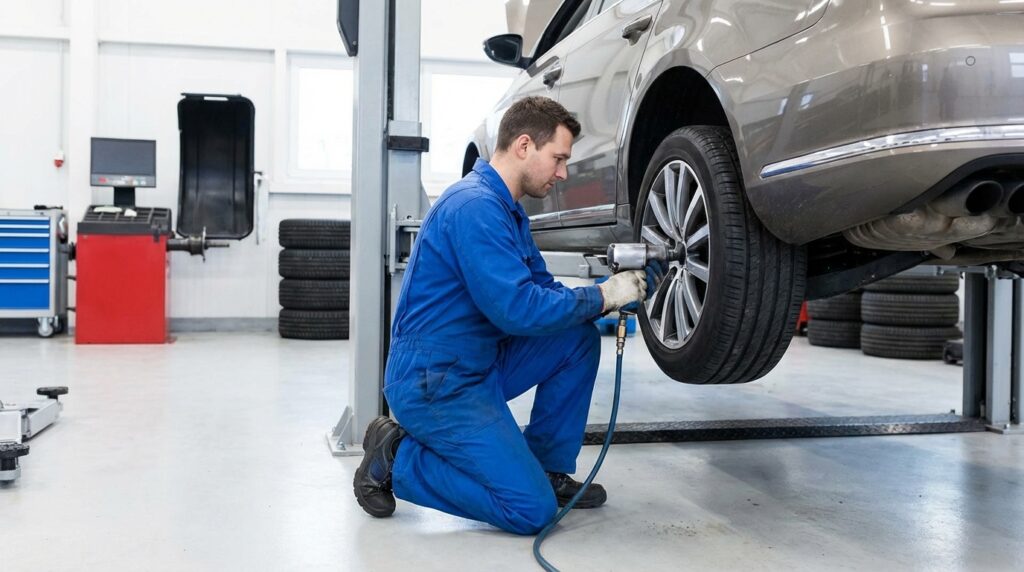
Tyre rotation requires lifting the car and removing all four wheels, so you cannot do it at home unless you have a professional jack stand set and proper tools. Here are your options in India:
- Authorised service centre: The safest option. Technicians know your car’s specific requirements and will use the correct pattern. Most service centres charge Rs. 200 to Rs. 500 for rotation.
- Local tyre shop: A good local tyre shop with a hydraulic lift can do this quickly and cheaply — often for Rs. 100 to Rs. 300. Make sure they know the correct rotation pattern for your car type.
- During scheduled servicing: The most convenient option. Ask your service centre to include tyre rotation with your regular service. Many dealers do it as part of the service package.
- Multi-brand service chains: Chains like Carnation, MyTVS, and 3M car care centres offer tyre rotation as a standalone service at fixed, transparent prices.
Common Tyre Rotation Mistakes to Avoid
Even a simple job like tyre rotation can go wrong if done incorrectly. Watch out for these common mistakes:
- Using the wrong rotation pattern: A directional tyre rotated side to side will wear incorrectly and can even be dangerous. Always check if your tyres are directional before rotation.
- Skipping the spare tyre: If your car has a full-size spare (same size as the other four), it should be included in the rotation every second cycle. This gives you five evenly worn tyres.
- Not checking alignment after rotation: Rotation is a good time to also check and correct wheel alignment. Misaligned wheels will cause the newly rotated tyres to wear unevenly again very quickly.
- Rotating too late: If one tyre is already significantly more worn than the others, rotation will not help much. Rotate on schedule — do not wait until wear is visible.
- Forgetting to re-check tyre pressure: After rotation, always check and set the correct pressure for each position — front and rear pressures may be different for your car.
Rotate Your Tyres — Save Money, Stay Safe
Tyre rotation is one of the highest return-on-investment maintenance tasks you can do for your car. For a cost of Rs. 200 to Rs. 500 every 8,000 to 10,000 km, you can extend the life of a full set of tyres by 20 to 30 percent. On a set that costs Rs. 20,000 to Rs. 50,000, that is a significant saving.
Mark your calendar or set a reminder for every 10,000 km. Know your car’s drive type — FWD, RWD, or AWD — and use the correct rotation pattern. And combine rotation with an alignment check for maximum benefit. Your tyres will last longer, your car will handle better, and your wallet will thank you.
Need quality tyres that last even longer with proper rotation? Browse our complete range of car tyres at the best prices in India. Visit our website today!