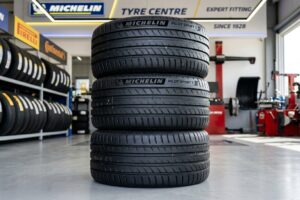
Your car’s tyres are the only part of the vehicle that actually touches the road. Everything else — the engine, brakes, suspension, steering — works through the tyres. Yet most Indian car owners pay very little attention to their tyres until something goes badly wrong, like a blowout on a highway or a loss of control in the rain.
The hard truth is that worn-out tyres are one of the leading causes of road accidents in India. The good news is that tyres give you clear warning signs before they fail — if you know what to look for. In this guide, we tell you exactly when to replace car tyres, what warning signs to watch out for, and how to do a quick safety check at home.
How Long Do Car Tyres Last in India?
There is no single answer because tyre life depends on several factors — driving style, road conditions, maintenance habits, and the quality of the tyre itself. However, here are the general guidelines followed by tyre manufacturers and experts:
| Factor | Typical Tyre Life | Notes |
| By mileage | 40,000 – 60,000 km | Varies by tyre brand and driving style |
| By age | 5 years (max) | Replace even if tread looks fine |
| Absolute maximum | 10 years | Never use a tyre older than this |
| City driving | 3 – 4 years | Stop-start traffic wears tyres faster |
| Highway driving | 4 – 6 years | Smoother wear, longer life |
Most tyre manufacturers recommend replacing tyres every 5 years regardless of how they look. After 5 years, the rubber compound begins to harden and crack even if the tread depth appears adequate.
7 Clear Warning Signs It Is Time to Replace Your Tyres
Do not wait for a blowout to tell you your tyres are done. Here are seven signs that mean your tyres need to be replaced immediately:
1. Tread Depth Below 1.6 mm — The Biggest Danger Sign
Tread depth is the single most important indicator of tyre safety. The grooves in your tyre grip the road and channel water away. As they wear down, grip reduces dramatically — especially on wet roads. In India, the legal minimum tread depth is 1.6 mm, but safety experts recommend replacing tyres when depth reaches 2–3 mm.
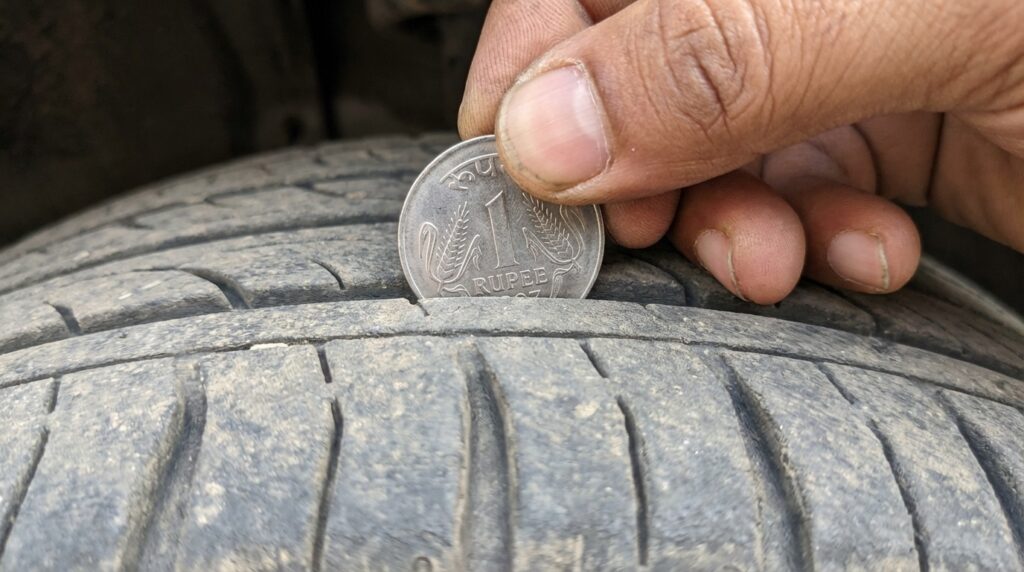
The Coin Test (Do This Right Now):
- Take a 1-rupee coin and insert it into the tyre groove with the rupee symbol facing down.
- If you can see the top of the rupee symbol, your tread is below 2 mm — replace your tyres immediately.
- If the rupee symbol is partially hidden, your tread is borderline — plan for replacement soon.
- If the rupee symbol is completely hidden, your tread depth is still acceptable.
2. Cracks or Cuts on the Sidewall
The sidewall is the vertical part of the tyre between the tread and the wheel rim. If you notice cracks, cuts, or grooves forming on the sidewall, this is a serious warning sign. Sidewall cracks are caused by UV exposure, ozone degradation, and old age — the rubber literally starts to fall apart from the inside out.
Even small sidewall cracks can lead to sudden tyre failure at speed. Do not ignore them. If you see cracking, especially around the base of the sidewall where it meets the rim, replace the tyre immediately.
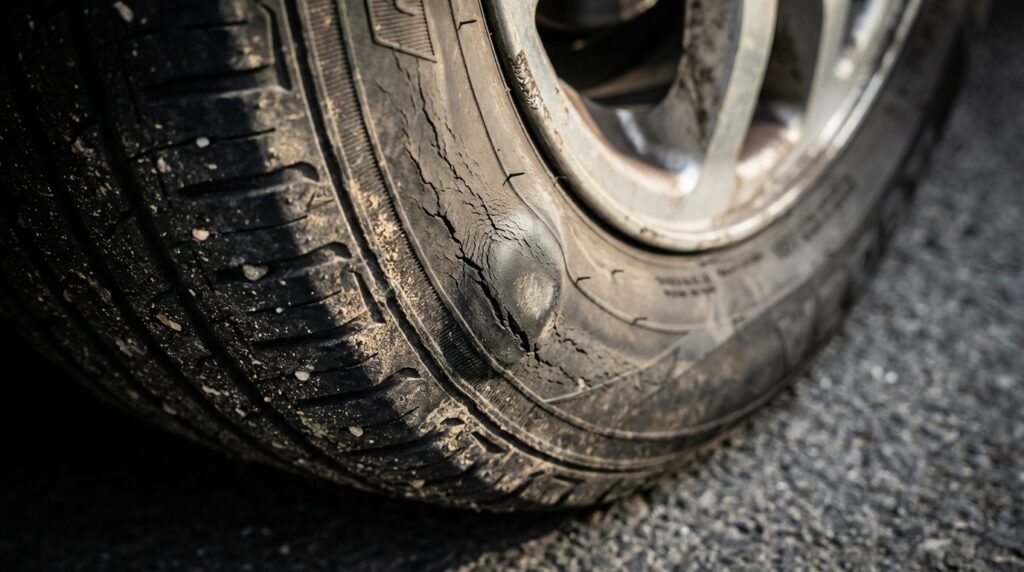
3. Bulges or Blisters on the Tyre
A bulge or blister on the sidewall or tread surface is a medical emergency for your tyre. It means the internal structure of the tyre has been compromised — usually from hitting a pothole or kerb hard. The bulge is the outer rubber being pushed out by the pressure inside because the internal fabric has torn.
A bulging tyre can blow out without any warning, even at moderate speeds. If you spot a bulge, do not drive any further than necessary. Replace the tyre the same day.
4. Excessive Vibration While Driving
Some vibration is normal on Indian roads. But if your car vibrates excessively even on smooth roads — especially at highway speeds — your tyres may be the culprit. Vibration can be caused by unbalanced tyres, internal tyre damage, or uneven tread wear. Sometimes the issue can be fixed with balancing or alignment, but if the tyres are worn or damaged internally, replacement is the only solution.
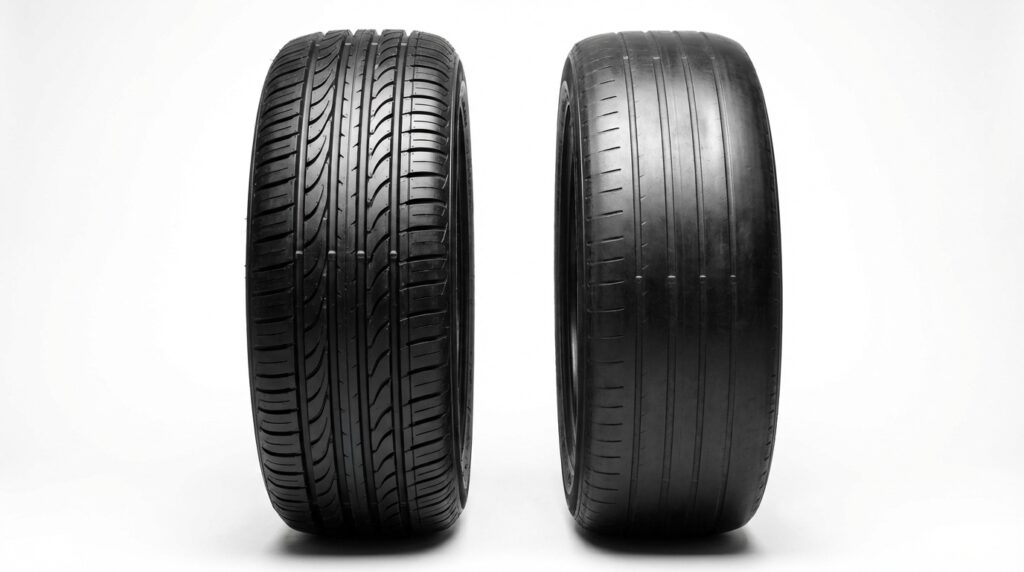
5. Uneven Tread Wear
Look at all four tyres and compare the wear pattern across the tread. If the tyre is worn more on one side than the other, or if there are bald patches in the middle with tread on the edges (or vice versa), this indicates a problem:
- Worn on both edges, good in centre: Tyre has been running under-inflated.
- Worn in the centre, good on edges: Tyre has been running over-inflated.
- Worn on one side only: Wheel alignment is off — fix alignment and consider replacing the tyre.
- Cupping or scalloping (wavy wear): Suspension or shock absorber problem — fix the root cause and replace the tyre.
6. Tyre Age Over 5 Years
Even if your tyres look perfectly fine on the outside, rubber degrades with age. After 5 years, the chemical compounds in the rubber begin to break down, reducing flexibility and grip — especially in extreme heat and monsoon conditions that India experiences.
How to check your tyre’s age: Look for the DOT code on the sidewall. The last 4 digits tell you the week and year of manufacture. For example, DOT code ending in 1823 means the tyre was made in the 18th week of 2023. If your tyres are over 5 years old, plan to replace them soon.
7. Tyre Has Been Repaired More Than Once
A single puncture repair on the tread area (not the sidewall) is generally safe if done professionally. But a tyre that has been repaired multiple times, or one that has been repaired on the sidewall, is structurally compromised. Multiple repairs weaken the tyre’s integrity, and the risk of sudden failure increases significantly. If your tyre has had more than one repair, it is time for a new one.
Should You Replace One Tyre or All Four?
This is a question many car owners struggle with, especially when only one tyre gets damaged. Here is the simple rule to follow:
- If all four tyres are fairly new and one gets damaged: Replace just the damaged tyre. Make sure the new tyre matches the brand, model, and size of the others.
- If tyres are old and one fails: Replace all four together. Mixing very new and very old tyres creates uneven grip that can make your car unpredictable — especially in emergency braking.
- If two tyres are done: Replace both tyres on the same axle (both front or both rear) together for balanced grip.
- For AWD and 4WD vehicles: Always replace all four tyres at the same time. Mismatched tyre sizes can damage the drivetrain.
How to Make Your Tyres Last Longer
Replacing tyres is an investment. Here is how to get maximum life out of every set:
- Check tyre pressure every 2 weeks: Incorrect pressure is the number one cause of premature tyre wear. Keep it at the manufacturer’s recommended level.
- Rotate tyres every 8,000 to 10,000 km: Front tyres wear faster than rear tyres. Rotating them ensures even wear across all four.
- Get wheel alignment every 15,000 km: Misaligned wheels cause rapid uneven wear on the inner or outer edges of the tyre.
- Balance your tyres when fitting new ones: Unbalanced tyres vibrate and wear unevenly.
- Avoid aggressive driving habits: Hard braking, rapid acceleration, and fast cornering all dramatically increase tyre wear.
- Park in shade when possible: UV rays and heat accelerate rubber degradation, especially in Indian summers.
Do Not Gamble With Your Tyres — Replace Them on Time
Your tyres are the foundation of your car’s safety. Worn, cracked, or bulging tyres do not just affect performance — they put your life and the lives of everyone in your car at risk. The cost of a new set of tyres is nothing compared to the cost of an accident.
Do the coin test today. Check for cracks and bulges. Look at the DOT date on your sidewall. If your tyres are showing any of the 7 warning signs we have covered, do not delay — visit a trusted tyre shop and get them replaced. Safe driving starts from the ground up.
Need to replace your tyres? Browse our wide range of premium tyres for every car and budget. Visit our website today and get expert advice from our team!