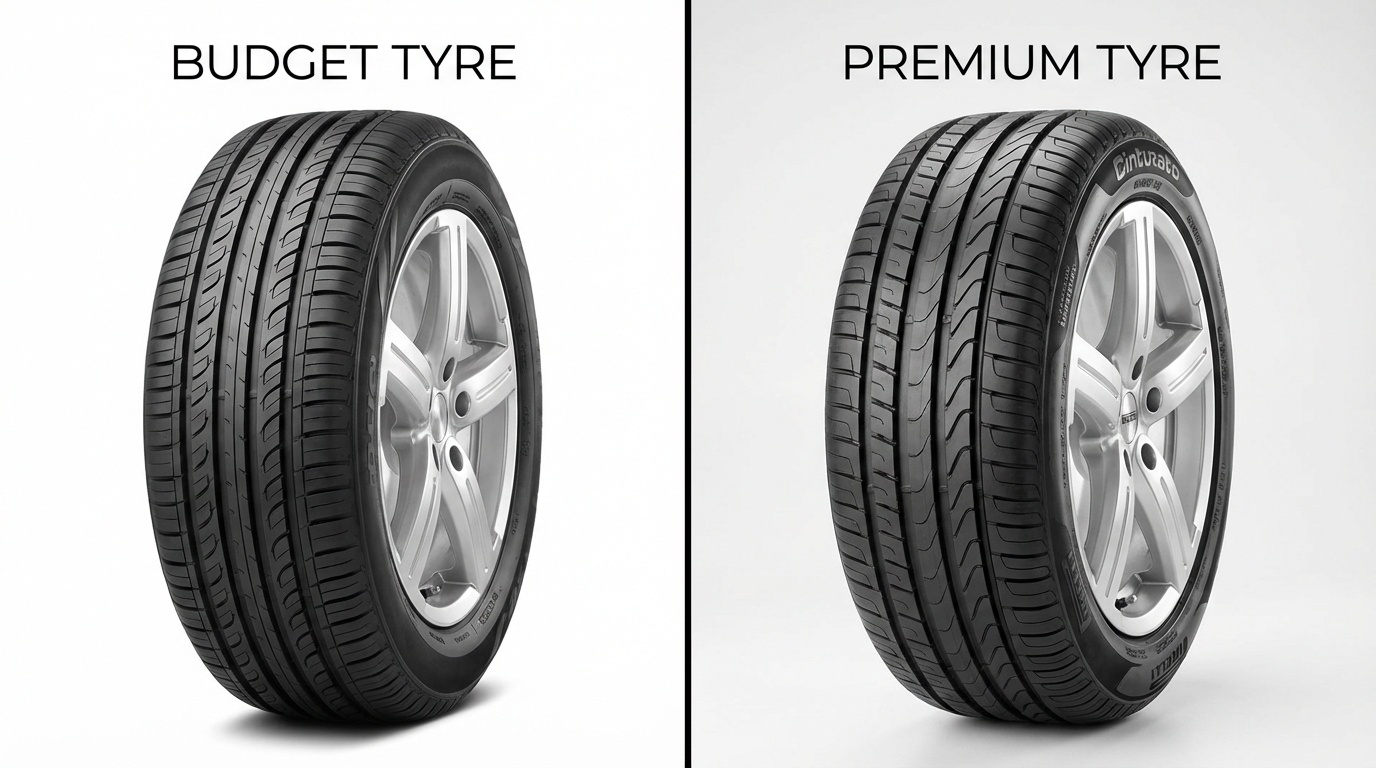
One of the most common dilemmas facing Indian car owners is whether to invest in premium tyres or save money with budget alternatives. With price differences often exceeding 100%, the decision significantly impacts both your wallet and driving experience. In this comprehensive budget vs premium tyre comparison, we’ll analyze every factor to help you make an informed decision that suits your specific needs and circumstances.
Understanding Budget and Premium Tyre Categories
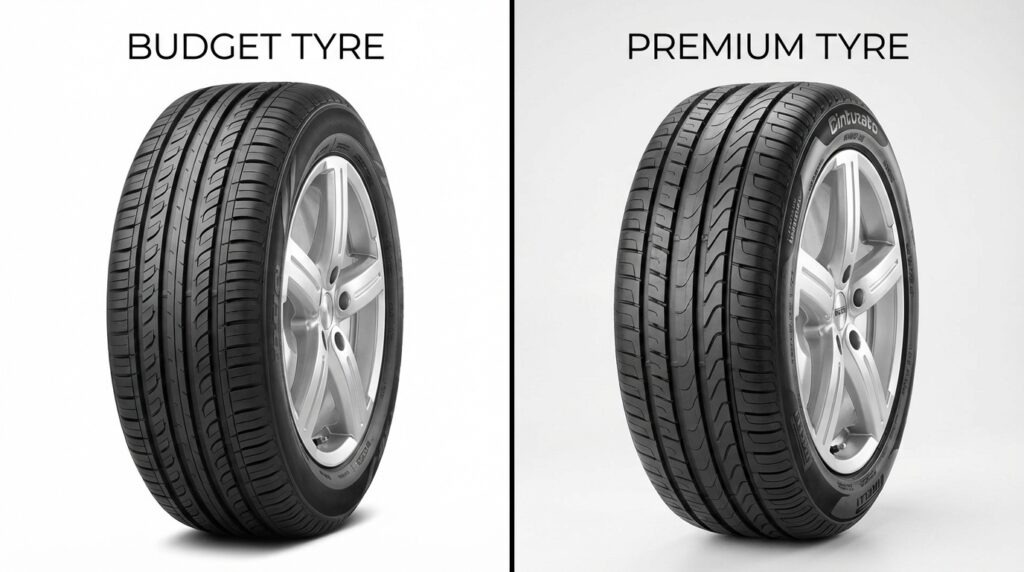
Before diving into comparisons, let’s define what constitutes budget versus premium tyres in the Indian market.
Budget Tyres Defined
Price Range: ₹2,500-₹4,500 per tyre (13-15 inch sizes)
Examples: MRF ZLX, JK Ultima NXT, basic Apollo and CEAT models
Target Audience: Cost-conscious buyers prioritizing affordability over ultimate performance
Engineering Focus: Basic functionality with emphasis on manufacturing efficiency and competitive pricing
Premium Tyres Defined
Price Range: ₹5,500-₹11,000 per tyre (13-15 inch sizes)
Examples: Michelin Energy XM2, Bridgestone Turanza, Continental PremiumContact
Target Audience: Quality-focused buyers prioritizing performance, safety, and longevity
Engineering Focus: Advanced technology, superior materials, extensive research and development
Mid-Range Category
Price Range: ₹4,000-₹6,500 per tyre
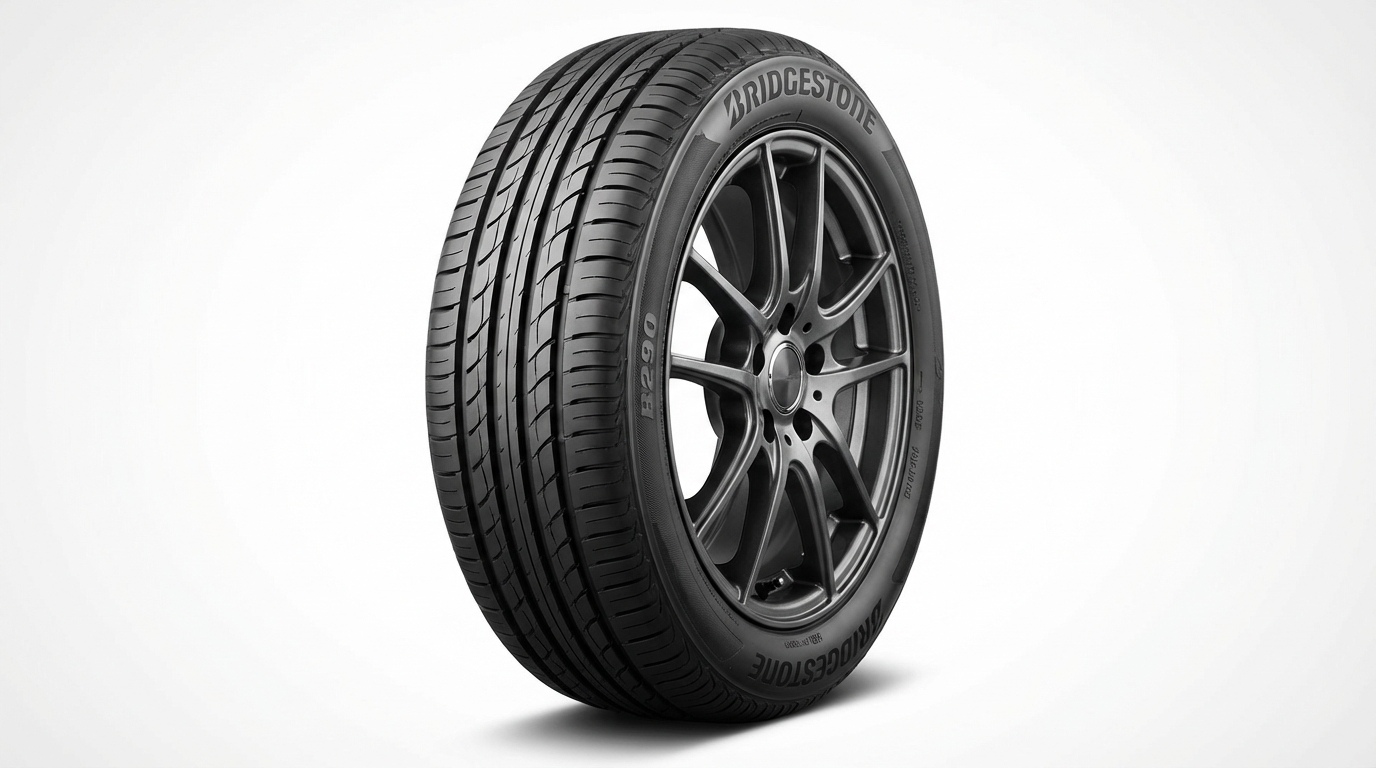
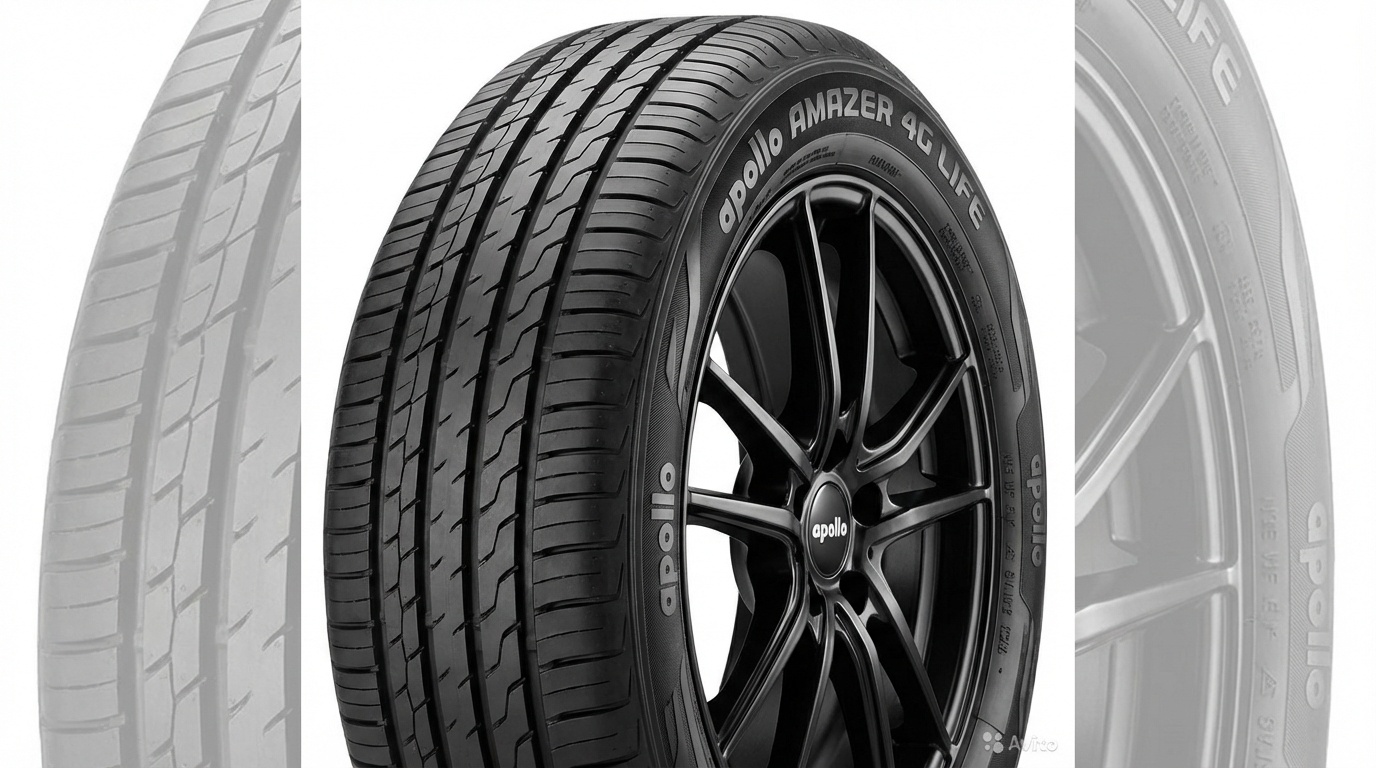
Examples: Apollo Amazer 4G Life, CEAT SecuraDrive, Bridgestone B290
Position: Balanced approach offering improved performance over budget with significant savings versus premium
Performance Comparison: Where Your Money Goes
Dry Road Performance
Budget Tyres:
- Adequate grip for normal city driving
- Acceptable highway stability up to 100 km/h
- Limited cornering capability
- Longer braking distances
- Basic tread compounds prioritizing cost over ultimate grip
Premium Tyres:
- Superior grip across all conditions
- Excellent high-speed stability (120+ km/h)
- Confident cornering with higher limits
- Shorter braking distances (potentially 10-20% improvement)
- Advanced silica-enhanced compounds maximizing grip
Real-World Impact: For daily commuting at moderate speeds, budget tyres suffice. For highway cruising, spirited driving, or heavy vehicles, premium tyres provide noticeable safety margins.
Wet Weather Performance
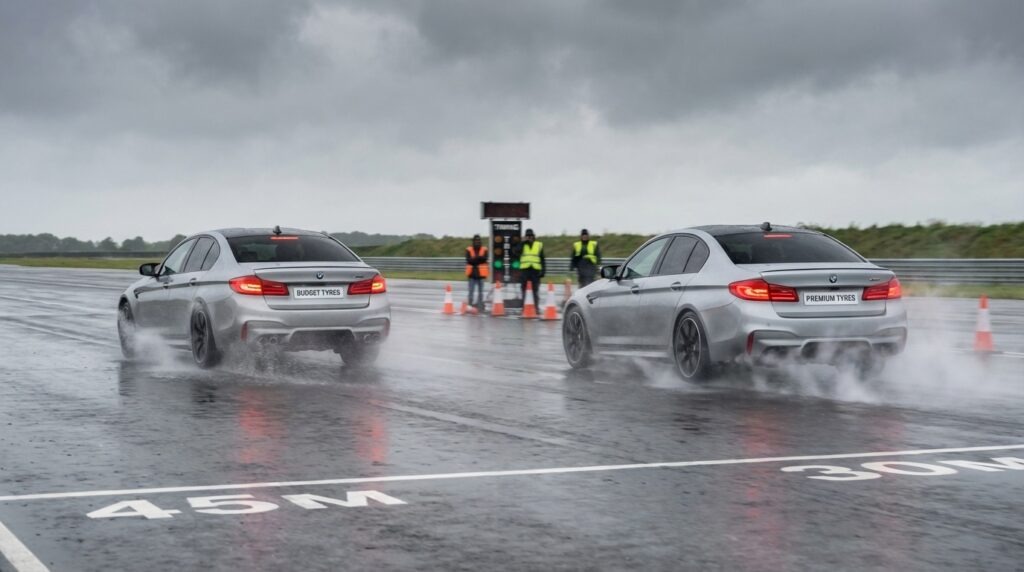
This category reveals the most significant performance gap between budget and premium tyres.
Budget Tyres:
- Basic water evacuation through simple groove patterns
- Adequate grip in light rain
- Noticeably reduced grip in heavy rain
- Higher hydroplaning risk at speed
- Conventional rubber compounds losing grip when wet
- Wet braking distances significantly longer than dry
Premium Tyres:
- Sophisticated groove patterns with optimized water channeling
- Minimal grip loss in light to moderate rain
- Confident performance even in heavy downpours
- Superior hydroplaning resistance
- Silica-enhanced compounds maintaining flexibility when wet
- Wet braking distances approaching dry performance
Safety Consideration: The wet weather performance gap represents the most critical safety difference. In emergency monsoon braking situations, premium tyres’ shorter stopping distances could prevent accidents.
Statistics: Independent tests show premium tyres can reduce wet braking distances by 15-30% compared to budget alternatives – potentially several car lengths at highway speeds.
Comfort and Noise Levels
Budget Tyres:
- Basic vibration dampening
- Noticeable road noise, especially on coarse surfaces
- Adequate comfort for city speeds
- Increased harshness over rough roads
- Noise levels rise noticeably as tyres wear
Premium Tyres:
- Superior vibration isolation through advanced construction
- Minimal road noise across all surfaces
- Comfortable ride across speed ranges
- Excellent pothole and rough road absorption
- Consistent noise levels throughout tyre life
Daily Impact: Over thousands of kilometers, premium tyres’ superior comfort reduces driver fatigue and enhances the ownership experience significantly.
Handling and Steering Feel
Budget Tyres:
- Adequate steering response for normal driving
- Limited feedback during spirited driving
- Progressive but early grip limits
- Forgiving handling characteristics
- Suitable for cautious, defensive driving styles
Premium Tyres:
- Precise, communicative steering feedback
- Higher grip limits with progressive breakaway
- Confidence-inspiring handling characteristics
- Superior stability during emergency maneuvers
- Engaging for enthusiastic driving styles
Durability and Longevity Analysis
One of the most important factors when comparing total value is expected lifespan.
Expected Tread Life
Budget Tyres:
- City driving: 30,000-45,000 km
- Mixed usage: 35,000-45,000 km
- Highway focused: 40,000-50,000 km
- Basic rubber compounds prioritize cost over longevity
- Wear acceleration as tread depth decreases
Premium Tyres:
- City driving: 55,000-70,000 km
- Mixed usage: 60,000-75,000 km
- Highway focused: 65,000-80,000 km
- Advanced compounds balancing grip and longevity
- More consistent wear rates throughout life
Longevity Difference: Premium tyres typically last 40-60% longer than budget alternatives – a crucial factor in total cost calculations.
Performance Degradation Over Time
Budget Tyres:
- Noticeable performance drop at 50% tread depth
- Wet grip deteriorates more rapidly
- Noise levels increase significantly with wear
- Comfort decreases as construction ages
Premium Tyres:
- Consistent performance even at 50% tread depth
- Wet grip remains strong throughout life
- Noise levels remain relatively stable
- Comfort maintained until replacement needed
Comprehensive Cost Analysis
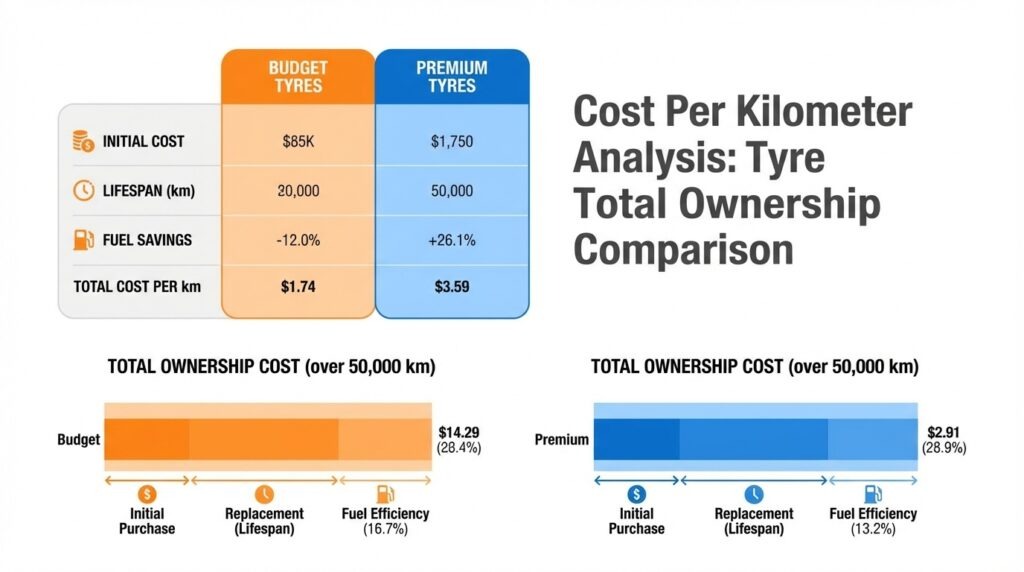
The most critical comparison for many buyers: what does each option truly cost?
Initial Purchase Cost Comparison
Budget Tyre Set (4 tyres – 14 inch):
- Cost: ₹12,000-₹16,000
- Installation: ₹800-₹1,200
- Total: ₹12,800-₹17,200
Premium Tyre Set (4 tyres – 14 inch):
- Cost: ₹24,000-₹32,000
- Installation: ₹800-₹1,200
- Total: ₹24,800-₹33,200
Initial Cost Difference: ₹12,000-₹16,000 (approximately 85-90% more)
Total Cost of Ownership (5 Years / 75,000 km)
Budget Tyre Scenario:
- Initial set: ₹14,000 (lasting 40,000 km)
- Second set: ₹14,000 (lasting 35,000 km remaining)
- Total tyre cost: ₹28,000
- Fuel consumption: Standard baseline
- Total ownership cost: ₹28,000
Premium Tyre Scenario:
- Initial set: ₹28,000 (lasting entire 75,000 km)
- Fuel savings: ~3% = ₹3,600 over period
- Total tyre cost: ₹28,000
- Net cost after fuel savings: ₹24,400
Surprising Reality: Over typical ownership periods, premium tyres often cost LESS than budget alternatives when considering:
- Fewer replacement intervals
- Fuel efficiency improvements
- Reduced maintenance from better wear characteristics
Cost-Per-Kilometer Breakdown
Budget Tyres:
- Average cost: ₹3,500 per tyre
- Average lifespan: 40,000 km
- Cost per km: ₹0.875
Premium Tyres:
- Average cost: ₹7,000 per tyre
- Average lifespan: 70,000 km
- Fuel savings: ₹2,000
- Effective cost: ₹5,000
- Cost per km: ₹0.714
Value Conclusion: Premium tyres deliver approximately 18% lower cost-per-kilometer while providing superior performance and safety.
Safety Considerations: The Unquantifiable Value
While cost matters, safety represents the most crucial consideration that transcends pure economics.
Emergency Braking Scenarios
In emergency situations requiring maximum braking:
Budget Tyres (from 80 km/h on wet roads):
- Stopping distance: ~65-75 meters
- Directional stability: Moderate
- ABS effectiveness: Good
- Overall control: Adequate
Premium Tyres (same conditions):
- Stopping distance: ~50-60 meters
- Directional stability: Excellent
- ABS effectiveness: Optimized
- Overall control: Superior
Critical Difference: 10-15 meter shorter stopping distance could mean avoiding accidents entirely – impossible to assign monetary value to preventing injury or death.
Monsoon Driving Safety
India’s monsoon season presents the most challenging conditions:
Budget Tyres:
- Adequate for cautious driving
- Require significant speed reduction in heavy rain
- Higher hydroplaning risk
- Limited safety margins
Premium Tyres:
- Confident performance in heavy rain
- Less dramatic speed reduction necessary
- Superior hydroplaning resistance
- Comfortable safety margins
Family Safety Consideration
For families with children or elderly passengers, the safety argument for premium tyres becomes even more compelling. The peace of mind knowing your vehicle has maximum grip during emergencies has intrinsic value beyond cost calculations.
Fuel Efficiency Impact
Often overlooked, tyre choice significantly affects fuel consumption.
Rolling Resistance Difference
Budget Tyres:
- Higher rolling resistance from basic compounds
- Standard fuel consumption baseline
- No specific efficiency optimization
Premium Tyres:
- Low rolling resistance through advanced engineering
- 3-5% fuel consumption reduction
- Green technology integration (Michelin Green X, etc.)
Annual Fuel Savings Calculation
Vehicle Profile:
- Annual distance: 15,000 km
- Fuel efficiency: 15 km/liter
- Fuel price: ₹100/liter
Budget Tyres:
- Fuel consumption: 1,000 liters/year
- Annual cost: ₹100,000
Premium Tyres:
- Fuel consumption: 950-970 liters/year (3-5% savings)
- Annual cost: ₹97,000-₹95,000
- Annual savings: ₹3,000-₹5,000
Over a tyre’s 4-5 year lifespan, these savings accumulate to ₹12,000-₹25,000 – substantially offsetting the initial premium.
Environmental Considerations
Beyond personal economics, environmental impact deserves consideration.
Carbon Footprint
Budget Tyres:
- Shorter lifespan means more frequent production
- Higher rolling resistance increases fuel consumption and emissions
- More tyres in landfills over time
Premium Tyres:
- Longer lifespan reduces production frequency
- Lower rolling resistance decreases fuel consumption and emissions
- Fewer replacement cycles reduce waste
Sustainability Factor
Premium manufacturers increasingly focus on sustainable materials and production processes, often including:
- Recycled materials in construction
- Reduced harmful chemicals
- Energy-efficient manufacturing
- End-of-life recycling programs
Vehicle Type and Usage Recommendations
Different vehicles and usage patterns favor different tyre choices.
Budget Tyres Make Sense For:
Older Vehicles (7+ years):
- Limited remaining vehicle life doesn’t justify premium investment
- Basic tyres adequate for vehicle’s capabilities
Very Low Mileage (under 8,000 km/year):
- Won’t utilize premium tyre’s longevity benefits
- Tyres may age out before wearing out
City-Only Driving:
- Limited high-speed or challenging conditions
- Budget performance adequate for stop-and-go traffic
Extremely Tight Budgets:
- When immediate affordability is paramount
- Safety meets minimum acceptable standards
Second Vehicles:
- Rarely used backup cars
- Minimal performance demands
Premium Tyres Make Sense For:
New or Valuable Vehicles:
- Premium tyres match vehicle quality and capabilities
- Protect significant automotive investment
High Annual Mileage (over 20,000 km/year):
- Long lifespan provides maximum value
- Cost-per-kilometer advantages maximized
Highway Driving:
- High-speed stability and safety crucial
- Comfort benefits appreciated over long distances
Family Vehicles:
- Safety margins protect precious cargo
- Peace of mind worth premium investment
Monsoon-Prone Regions:
- Wet weather performance differences most critical
- Safety benefits justify cost premium
Performance Vehicles:
- Premium tyres necessary to utilize vehicle capabilities
- Budget tyres limit performance potential
The Mid-Range Compromise
For many drivers, mid-range tyres offer the optimal balance:
Mid-Range Advantages
Performance:
- Significantly better than budget alternatives
- Approaches premium performance in most scenarios
- Modern technology at accessible pricing
Cost:
- 30-50% premium over budget tyres
- 30-40% savings versus premium alternatives
- Competitive cost-per-kilometer
Best For:
- Practical drivers seeking balanced value
- Mid-size sedans and hatchbacks
- Moderate annual mileage (12,000-20,000 km)
- Mixed driving conditions
Making Your Decision: A Practical Framework
Step 1: Assess Your Priorities
Rank these factors from most to least important for your situation:
- Initial purchase cost
- Safety (especially wet weather)
- Longevity/durability
- Comfort and noise
- Fuel efficiency
- Brand reputation
Step 2: Calculate Your Usage Pattern
Consider:
- Annual kilometers driven
- City vs. highway percentage
- Typical weather conditions
- Vehicle age and value
- Planned ownership duration
Step 3: Run Your Numbers
Calculate total ownership cost including:
- Initial purchase
- Expected lifespan based on usage
- Fuel efficiency impact
- Replacement frequency
- Safety value (assign subjective worth)
Step 4: Match Tyre to Requirements
Choose Budget If:
- Priorities: Cost, basic functionality
- Usage: Low mileage, city only, older vehicle
- Budget: Severely constrained
Choose Mid-Range If:
- Priorities: Balanced performance and value
- Usage: Moderate mileage, mixed conditions
- Budget: Reasonable flexibility
Choose Premium If:
- Priorities: Safety, performance, longevity
- Usage: High mileage, highway, family vehicle
- Budget: Adequate for quality investment
Expert Recommendations by Scenario
Scenario 1: Young Family in Mumbai
Vehicle: Maruti Suzuki Swift
Annual Mileage: 15,000 km
Priority: Safety during monsoons
Recommendation: Premium or mid-range tyres
Reasoning: Monsoon safety justifies investment; moderate mileage utilizes longevity
Scenario 2: Retired Couple in Jaipur
Vehicle: Hyundai i10
Annual Mileage: 6,000 km
Priority: Comfort, low noise
Recommendation: Mid-range tyres
Reasoning: Low mileage doesn’t utilize premium longevity; mid-range provides adequate comfort
Scenario 3: Sales Professional in Bangalore
Vehicle: Honda City
Annual Mileage: 30,000 km
Priority: Longevity, fuel efficiency
Recommendation: Premium tyres
Reasoning: High mileage maximizes cost-per-kilometer advantages and fuel savings
Scenario 4: Student with 10-Year-Old Car
Vehicle: Maruti Suzuki Alto
Annual Mileage: 8,000 km
Priority: Minimal cost
Recommendation: Budget tyres
Reasoning: Vehicle age and low mileage don’t justify premium investment
Common Myths Debunked
Myth 1: “Budget Tyres Are Just as Safe”
Reality: While meeting minimum safety standards, budget tyres show measurably longer braking distances and reduced wet grip – critical safety differences.
Myth 2: “Premium Tyres Are Just Marketing”
Reality: Extensive independent testing consistently demonstrates measurable performance differences across all categories.
Myth 3: “All Tyres Wear Out at the Same Rate”
Reality: Premium tyres’ advanced compounds and construction typically last 40-60% longer than budget alternatives.
Myth 4: “You Should Match Your Car’s Price Point”
Reality: Usage patterns, safety priorities, and total ownership costs matter more than vehicle value alone.
Myth 5: “Tyre Brand Doesn’t Matter”
Reality: Established brands invest heavily in R&D, quality control, and customer service – differences that manifest in real-world performance.
Final Verdict: The Smart Choice Depends on YOU
There is no universal “correct” answer in the budget vs premium tyre debate. The right choice depends entirely on your specific circumstances, priorities, and usage patterns.
Budget Tyres Win When:
- Initial cost is paramount constraint
- Low annual mileage limits longevity benefits
- Older vehicles with limited remaining life
- Basic city driving doesn’t demand premium performance
Premium Tyres Win When:
- Safety is the primary priority
- High annual mileage maximizes cost-per-kilometer advantages
- Highway driving and long distances are common
- Family transportation demands maximum safety margins
- Total ownership cost matters more than initial price
Mid-Range Offers Best Balance When:
- Moderate budgets and moderate demands
- Practical approach to balanced performance
- Significant upgrade from budget without premium pricing
- Most common real-world usage scenarios
Conclusion: Invest Wisely in Your Safety
Your tyres represent the only contact between your vehicle and the road – four palm-sized patches of rubber upon which your safety depends. While budget constraints are real and valid, understanding the true cost differences (often smaller than initially perceived) and performance gaps (often larger than expected) enables informed decision-making.
For many Indian drivers in 2026, the total ownership cost analysis reveals that premium tyres actually represent superior value despite higher initial investment. The combination of extended lifespan, fuel savings, and crucially superior safety creates a compelling value proposition that transcends simple price comparison.
However, for specific usage scenarios – particularly low-mileage city driving in older vehicles – budget tyres adequately meet requirements at genuinely lower cost.
The wisest approach: honestly assess your situation, calculate YOUR specific total ownership costs, assign appropriate value to safety considerations for YOUR family, and choose accordingly. There’s no shame in either decision when made with full information and honest self-assessment.
Your tyres are too important for decisions based solely on initial price tags or assumptions. Do the analysis, understand the trade-offs, and invest appropriately in the safety equipment that literally keeps your family connected to the road.